
Quick question. Which of your accounts ends in 4432?
Unless you have a remarkable memory for digits, you probably had to think about it. Maybe you opened your banking app to check. And yet that is how almost every financial app in India shows you your own money: a bank logo, a masked number, and the hope that you remember which is which.
Nobody thinks about their money that way. You think "the salary account", "the one I keep for SIPs", "the travel card", "Mom's SBI". The number is the bank's label. The purpose is yours.
Recognition over recall
There is an old principle in interface design that we lean on a lot at Fold: recognition over recall. It is easier for people to recognise something they can see than to recall something from memory. Good software keeps the context you need on screen instead of asking you to remember it.
You can see this all over Fold if you look. When you tag a transaction, the transaction stays visible while you pick the tag. When you split a payment or add a refund, the original amount stays in view. When a card bill is due, the card's name and the amount sit together.
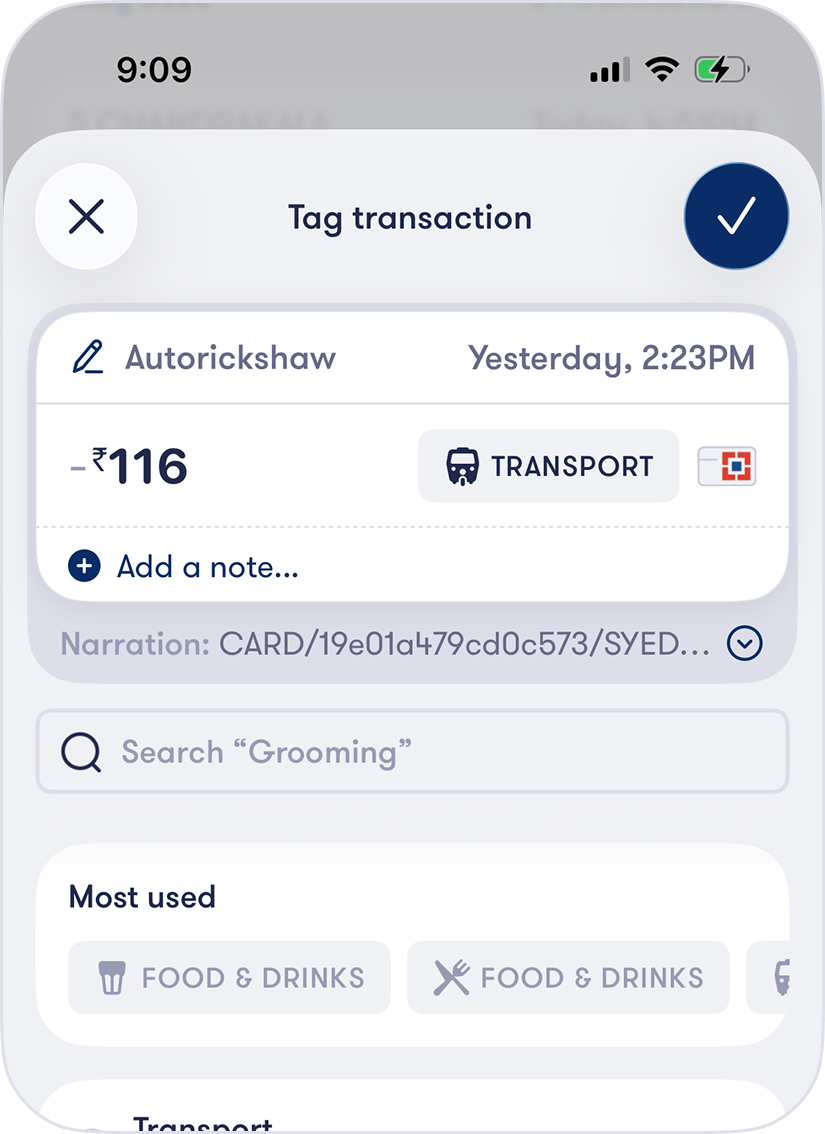
The reason is not aesthetics. Every act of recall, however small, costs a little bit of attention. Which account is this? Was this the card with the higher limit? Did this debit come from my account or the one I manage for my parents? One of these questions is nothing. Dozens of them a week, every time you look at your money, add up to the low-grade tiredness most people associate with personal finance. A lot of what we build is about removing those tiny taxes.
Masked account numbers are one of the most common of them, and one of the easiest to fix.
Name it after what it does
On Fold, you can give any connected bank account or credit card a nickname. So instead of ••••4432 and ••••5191 you see "Spending account" and "Shopping card".
Once you nickname an account, that name shows up throughout the app: in your transactions, your balances and your card dues. It is a small change that makes every other screen a little easier to read.
A few ways people use it:
By purpose. "Salary", "Bills", "SIP account", "Emergency fund". If you keep different accounts for different jobs, naming them after the job makes it obvious when money is in the wrong place, for example when the SIP account is running low two days before the debit.
By person. Many people on Fold keep an eye on a parent's or partner's account alongside their own. "Mom's SBI" is far easier to scan than a second SBI logo with a different set of digits.
By card. "Travel card", "Groceries", "Amazon card", "Fuel". If you pick cards for their rewards, naming them after what you use them for doubles as a reminder of which card to reach for.
How to do it
- Go to Profile → Bank Accounts (or Cards).
- Tap the account or card you want to rename.
- Tap the underlined name at the top.
- Type a name and tap Save.
To go back to the original name, follow the same steps, clear the field and tap Save.
The little things
Nicknames are not a headline feature. Nobody downloads a finance app because it lets them rename an account. But we think software that handles your money should feel calm, and calm is mostly made of little things like this: being able to hide your balances with a tap when someone is looking over your shoulder, or marking an old account as closed while keeping its history.
None of these change what your money is doing. They change how much effort it takes to understand it. That is the part we care about.
If you have not tried it, open Fold and give one of your accounts a proper name. And if there is a small thing in Fold that annoys you every time you see it, tell us at [email protected]. Those are often our favourite fixes.
Update, June 2026: nicknames now work for fixed deposits too, so an FD can be "House down payment" instead of a deposit number and a maturity date.